Logging
After the tree has been successfully felled, the felled wood must be transported (hauled) to the access road.
What is timber hauling?
The term “log hauling” refers to the transport of felled tree trunks from the forest for further processing. Machines such as tractors, draft horses, or cable winches are used for this purpose. The goal is to harvest timber in a way that protects the soil and is efficient, in order to minimize environmental impact and promote sustainability in forestry.
Pre-press and post-press
The process of moving timber (whole logs, raw trunks, assorted sizes) from the stand to the skid trail is called “advance skidding.” If the timber is then transported directly to the landing, this is referred to as “final skidding.”
Our innovative methods and technologies for sustainable timber hauling
Manual Log Hauling:
In modern, profit-driven forestry, this method of transport has already been phased out in order to work more efficiently and ergonomically. Today, machines such as forwarders and tractors perform the work that once kept many forest workers busy.
Long-log skidding:
LAS transports long logs using skidding machines such as forwarders or tractors. The logs are skidded individually or in larger groups to the landing along the log haulage route. Particular attention must be paid here to the dimensions and weights of the logs. Therefore, increased concentration while driving is necessary to prevent damage to the logs or to the machines.
Short-log hauling:
Short-length logs are hauled using forwarding machines such as forwarders or tractors. The logs are hauled individually or in larger groups to the landing along the log haulage route. The dimensions and weights of the logs are particularly important to consider here. A forwarder can usually transport two rows of short-length logs. This allows more wood to be moved at the same time. It is particularly important to note the increased weight of the machine, which can now weigh up to several metric tons.
Wooden crating:
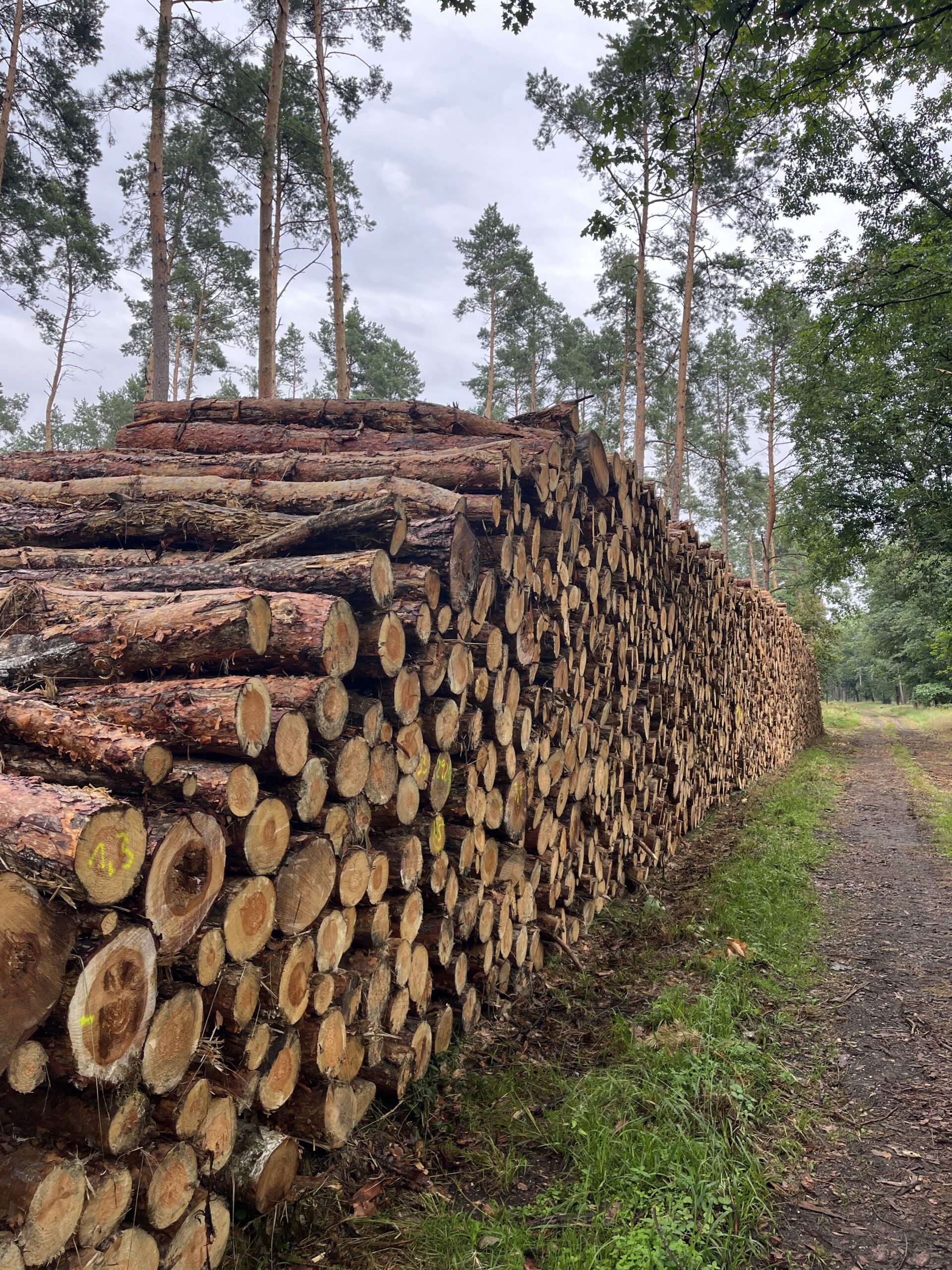
The timber is (usually) stacked by the driver of the forwarder. The driver is responsible for separating different grades of wood. This is the only way to ensure optimal marketing and the proper transport of the timber. To this end, the timber piles must be clearly visible and located along paths accessible to trucks. On the other hand, they must be protected from timber thieves, which is why a balance must be struck between these various considerations.
Customer Testimonials
Your Experts in Log Hauling
We are here to provide you with expert assistance on all matters related to timber hauling. Schedule a no-obligation consultation today and benefit from our experience and state-of-the-art technology.
How We Haul Timber – Our Methods and Machinery
The choice of skidder depends not only on the dimensions of the timber but also on the conditions of the site. For example, long timber can be moved by forestry and cable skidders, while short timber can be moved by carrier skidders and forwarders. If the ground is wet, very wet, or even boggy, we use special tires or bog tracks. This ensures that loads can be optimally distributed despite the poor conditions. The specific equipment of the vehicle depends on the individual requirements of the timber and ranges from a trailer with stanchions to a loading crane.
Your Experts in Log Hauling
We are here to provide you with expert assistance on all matters related to timber hauling. Schedule a no-obligation consultation today and benefit from our experience and state-of-the-art technology.
Forwarder
The classic forwarder is used as a skidder. The driver is protected by the cab while driving. It is important to always pay attention to the condition of the ground and the trees to prevent potential damage to the stand. It uses a crane arm to collect timber set aside in the stand, temporarily stores it on its skidder trailer, and moves it forward or stacks it along the haulage route in various assortments. The operator must remain fully focused at all times to distinguish between different qualities. This is the only way to ensure a specific haulage.
We operate either as a fully mechanized team of a harvester and a forwarder or as a partially mechanized system with motor-assisted manual loading. Our machines can even navigate slopes. If the slope is too steep, traction technology is used—either for the timber or for the machine.
Soil-Conserving Log Hauling:
To minimize impact on the forest floor and drive gently through the stand, tracks or chains can be attached to the machines’ wheels. These minimize shear forces and prevent the wheels from sinking too deeply into the forest floor. However, they can only be used for moving within the forest. Paved roads are off-limits, as they can cause permanent damage.
Forwarder Accessories:
Various attachments, such as reinforced stanchions for transport or extended crane booms, can be mounted on the forwarder. In addition, tracks or chains are installed to protect the ground in wet terrain.
Tugboat
Various types of tractors are used in forestry. Their features and efficiency depend on the operator and the type of work being done.
A distinction is made between clamping-bench, cable, and specialized forestry tractors. Standard agricultural tractors, for example, are used in combination with rear blades to increasingly skid larger individual logs in small private forests. Specialized users employ forestry-specific tractors. These are not only significantly sturdier but are also specifically designed for skidding operations and are therefore more efficient. Both types are typically cable tractors used for skidding timber on terrain that is difficult to navigate.
The skidder, on the other hand, transports the logs on a conveyor behind the cab. This method is typically used only in areas with better terrain conditions, specifically for skidding LAS.
Log trailer
The skidder is attached to a tractor and is used to transport and load various types of timber. It represents a step from the conventional tractor toward the forwarder. The forwarder has its skidder permanently mounted and operates as a single machine.
Your Experts in Log Hauling
Lightfoot Harvesting GmbH is happy to assist you with a wide variety of tasks and challenges you may encounter while managing your forest.
If you have any questions, we are, of course, available to assist you and provide further guidance.