Timber harvesting
Preparation and Procedure
Professionals in Timber Harvesting
Before any upcoming work begins, we must clearly communicate what we need to do to best meet your requirements. On-site consultation is usually the best way to do this. This allows everyone involved to get a sense of the condition of the stand and clearly define the timber harvesting method.
All known partially and fully mechanized methods of timber harvesting are available; however, special attention must be paid to the factors that determine the stand in order to carefully select the appropriate machine equipment. This is the only way to ensure that the soil and the stand are treated with the utmost care.
Timber Harvesting – Planning and Consulting
If you’re planning a logging project, we’ll come to you to discuss all the necessary details. It’s best to schedule an appointment for this.
We also offer to work with you to plan specific measures for the long term. This makes it possible to use machinery efficiently across multiple hunting grounds and for numerous landowners.
Timber Harvesting Methods
The following timber harvesting methods are available:
- Fully mechanized standing harvest with the Königstiger
- Fully Mechanized and Partially Mechanized Harvesting with Conventional Harvesters
- Fully Mechanized and Partially Mechanized Skidding
- Fully Mechanized Loading
Customer Testimonials
Do you need help with logging?
As experts in timber harvesting, you’ve come to the right place. Contact us today for a no-obligation quote.
Mechanized Timber Harvesting
Today, mechanized timber harvesting is mostly carried out using partially or fully mechanized methods. For this reason, harvesters and forwarders—or “harwarders” (a combination of the two)—come in a wide variety of sizes and configurations. The increasing degree of mechanization is determined by numerous environmental factors and limited financial resources for in-house labor.
As a result, professional timber harvesting is usually carried out by companies such as Lightfoot Harvesting GmbH.
With our wide range of machines and procedures for a variety of procedures, we offer you the right solutions.
Harvesters and Forwarders
In modern forestry, working without heavy machinery has become virtually unthinkable. As a result, harvesters and forwarders are now widely used in logging and skidding operations.
The classic harvester is a fully mechanized timber harvesting machine operated by a single operator. The operator is protected inside the machine by safety features and an operator’s cab that, depending on the model, cannot be penetrated even upon contact with branches.
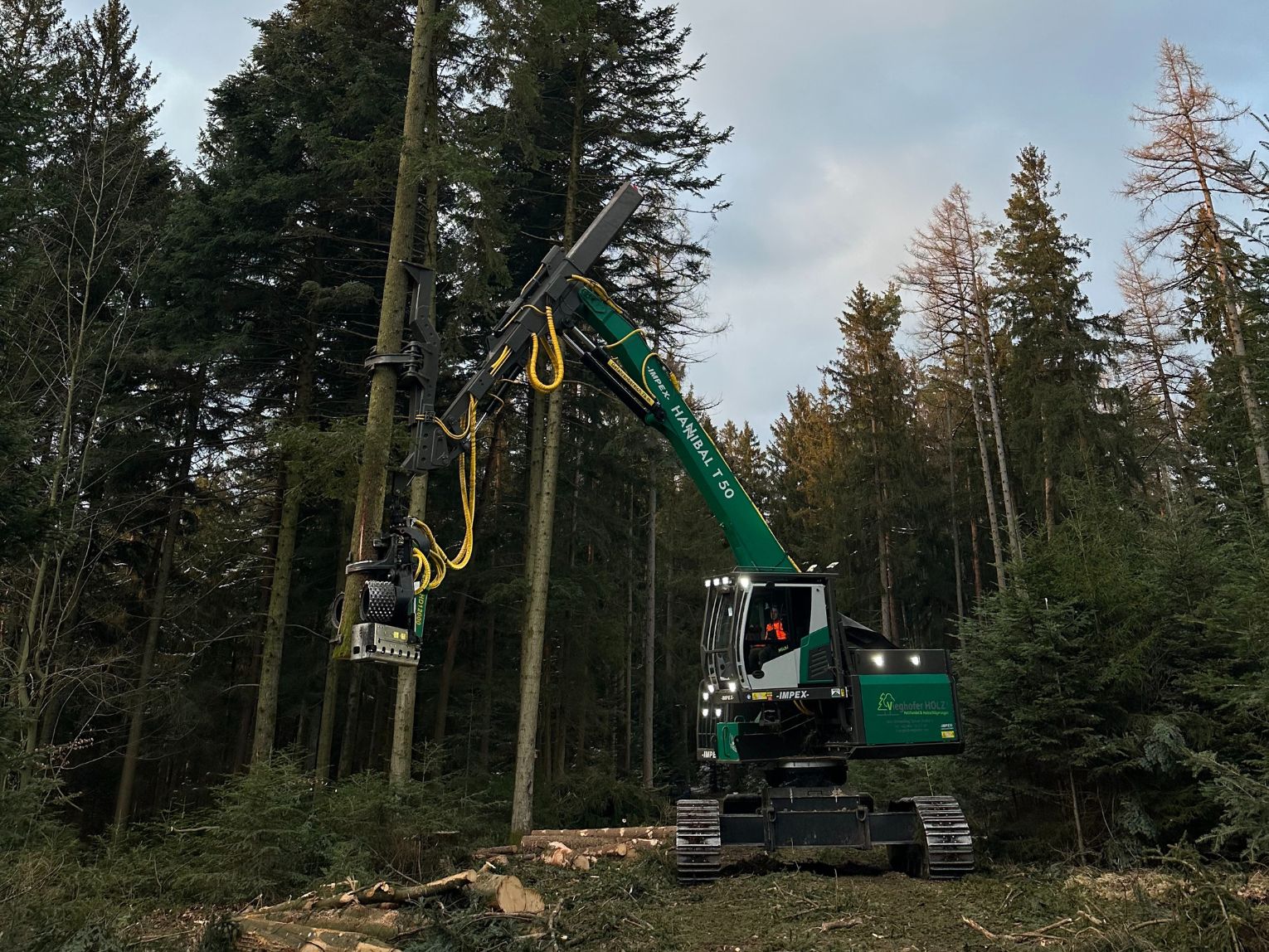
Furthermore, the newer Königstiger models can adjust the height of their cabs up to 2.80 meters to maintain a clear view within the building. Depending on the model, the crane boom with power unit can reach up to 15 meters into the stock and can therefore also be used in the FSC-certified 40-meter aisle system.
We use conventional harvesters as well as the Königstiger T 25, T 30, T 40, and T 50. This allows us to handle all strength classes, and with additional tracks for the machines, we can work even under difficult ground conditions.
The classic forwarder is used as a skidding machine. It uses a crane arm to collect timber that has been laid out in the stand and moves it forward, or stacks it along the haulage route in various assortments. The operator must remain focused at all times to ensure that different qualities are clearly separated. This is the only way to ensure a specific type of haulage.
We operate either as a fully mechanized two-vehicle team consisting of a harvester and a forwarder, or as a partially mechanized operation using a combination of motorized and manual skidding. Our machines can even navigate slopes. If the slope is too steep, traction equipment is used—either for the timber or for the machine.
Advantages of Mechanized Timber Harvesting
In addition to safe and efficient work methods, the clear advantages of mechanized timber harvesting naturally include savings on labor costs. Today, it is unthinkable to move in-demand products such as LAS (long timber sections) without the use of machinery. As a result, forest workers are more likely to be deployed in motorized-manual logging or in less hazardous maintenance work.
The Benefits at a Glance:
- Faster Precipitation and Processing
- Faster Recoil
- Faster Loading
- Greater Safety for Workers
- Higher Profits Through Greater Efficiency
It quickly becomes clear that the benefits extend to nearly all areas of forestry work. Nevertheless, foresters still have plenty of tasks to perform in the areas of forest maintenance and logging.
All in all, this makes work safer and more efficient.
Use of Specialized Machinery
When conventional harvesters and forwarders reach their limits, specialized equipment is brought in. This is used primarily on steep slopes or on sensitive soils. Lightfoot Harvesting GmbH uses special bog tracks for conventional machines to reduce the shearing effect of the tires on wet ground.
When we drive on steep slopes in the Thuringian Forest, we decide whether to use traction control based on the slope’s gradient. This increases the drivability of slopes from 35% to 50%.
With our technology, it is also possible to harvest trees—which would traditionally fall under the category of large-diameter timber—using the new Königstiger T50, T40, and T30.
Organizational Workflow for Timber Harvesting
If you’re planning a logging operation, we’re here to support you with expert advice and the machinery needed to carry it out. After inspecting the forest, we’ll discuss your specific needs and select an appropriate timber harvesting method. We’ll also choose the appropriate machinery, paying particular attention to soil conditions and the timing of the harvest.
Once logging is underway, we can always make adjustments and expand the logging volume as needed. Once the timber has been stacked, it is hauled away promptly. We, of course, handle the marketing.
Lightfoot Harvesting GmbH
Francesco Börner
Bergstraße 26
06905 Bad Schmiedeberg / Söllichau
Phone: 015221853462
Email: info@lf-harvesting.de
Logging
Logging encompasses all stages of timber harvesting, such as felling, processing, sorting, and, if necessary, skidding to the skid trail (as is the case, for example, with logging using harvesters).
To this day, traditional logging horses and forestry tractors are still used alongside highly advanced machinery. This work can then be performed by ordinary forest workers and, in some cases, contractors without any special training on the machinery. However, when felling or harvesting large quantities of timber on uneven terrain, contractors with their own machinery are often called upon.
Logging
Hauling using forwarders, cable skidders, or combination machines. Dumping along forest roads that are accessible to trucks year-round.
Wooden Holder
Photo-optical or cross-sectional image of a bundle or individual log in the case of roundwood.
Other Timber Harvesting Methods at LF Harvesting
In standing harvesting, the tree is lifted out of the stand while still standing, with the harvester positioned on the skid trail. Unlike with conventional harvesters, the tree does not fall into the stand during felling but is delimbed and cut to length on the skid trail. This protects the emerging regrowth and other trees. Furthermore, skidding damage is the exception rather than the norm, as is the case with conventional methods.
This protects natural regeneration, which is not damaged by the falling tree. And this also benefits the ecosystem. Through natural regeneration, you automatically use native plants that are well-adapted to the site for your reforestation efforts. This helps create a near-natural, species-rich mixed forest.
Lightfoot Harvesting uses the new method of standing harvest. The key to this technique is lifting the tree with the harvester as a whole tree—that is, in one piece—from the closed stand and felling it onto the skid trail. This greatly reduces damage to the remaining trees. Processing and sorting then take place right on site, which makes the forwarder’s job much easier.
The layer of rice husks that forms on the aisle also helps preserve the crop. This allows the track system—which is already gentle on the soil—to distribute its weight even more effectively.
If you have any questions, we are happy to assist you and provide personalized, professional advice.