Problems with Tree Removal
If a dying tree is located immediately next to a public right-of-way, it is considered a problem tree that should be removed to ensure the safety of those using the right-of-way. This is one of many situations that can lead to the removal of a problem tree.
An Overview of Problem Tree Removal
For a tree to be designated as a problem tree and felled, numerous factors must come into play. Its location near critical infrastructure or public transportation routes are just a few examples. Once a tree has been identified as a problem, an efficient felling method must be selected. A wide variety of methods are available for this purpose.
This is followed by communication with the relevant authorities and the execution of the felling.
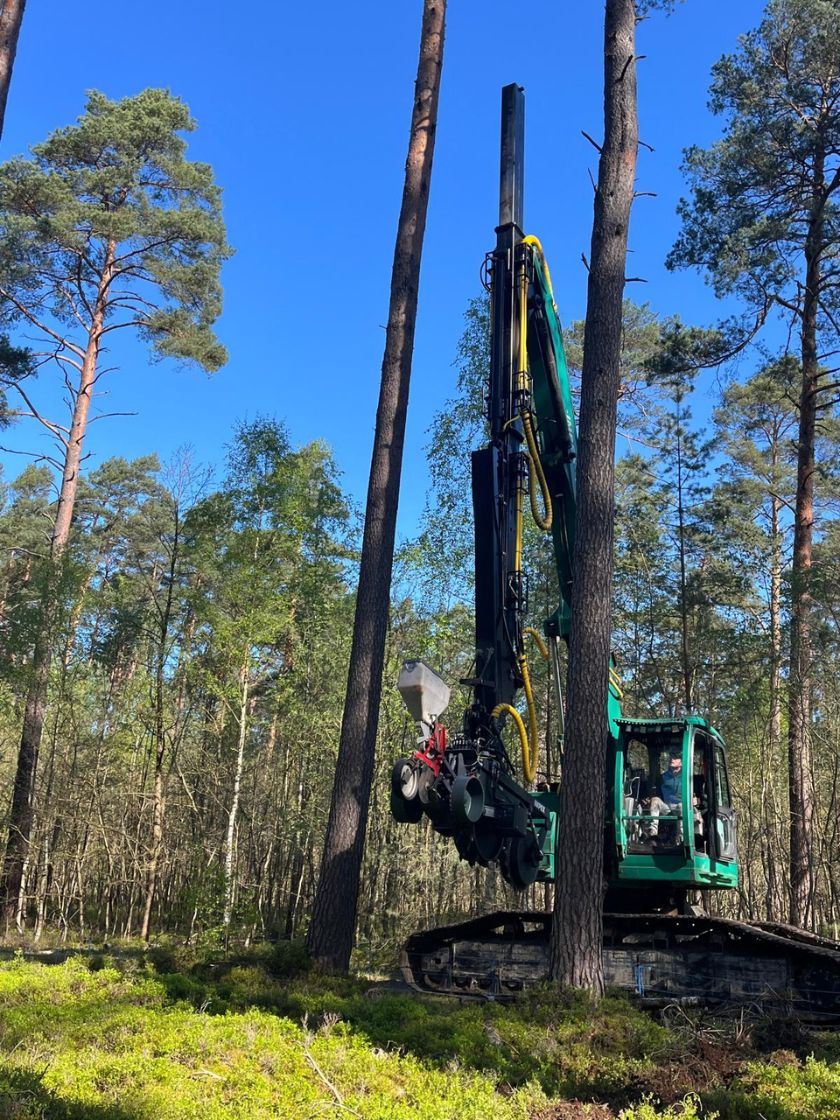
Fällraube
Unlike manual felling using rope access techniques (SKT) or other methods, the felling crawler offers a more efficient alternative. If it is too risky to have personnel work on the tree, the felling crawler is used. Even with severely damaged trees where large branches are expected to fall, the machine operates safely via remote control.
Since it is equipped with hydraulic gripping and cutting tools, it can fell and remove any tree in a controlled manner, even in the tightest of spaces.
Standing milking
Forestry Tractor
The forestry tractor offers a traditional method of tree removal. A worker attaches a rope to the tree, which the tractor then pulls. This method can be carried out by a single person and is efficient. However, it requires more space because the machine pulls the tree. Consequently, increased safety measures and risks must be taken into account.
Customer Testimonials
Felling Problem Trees Safely and Efficiently
What happens to the wood?
After felling, the trunk is processed. Since most problem trees must be cut down due to a lack of vitality, some compromises in wood quality must be accepted.
A typical use for problem trees is traditional firewood. Of course, this is not done on a for-profit basis, but that shouldn’t be the goal. Rather, the focus is on complying with the duty to ensure public safety.
Questions and Answers About Problem Tree Removal
Problem tree removal is not like regular tree removal. There are many important factors to consider in order to work safely and efficiently.
Below is a selection of typical questions with possible answers.
What are the reasons for removing a problem tree?
Typical criteria for a problem tree include, for example:
- Diseases or insect infestations
- Damaged structures such as branches, roots, or hollow trunks
- Tilt
- Proximity to structures or power lines
How do you fell a tree so it doesn’t lean?
Using special pulling techniques with a tractor or crawler, a tree can be felled against the direction of its lean. To do this, simply attach a rope to the tree at a certain height and pull it down so that it falls in one piece as much as possible.
How do you apply to have a problematic tree removed? / What kinds of problems might arise?
A permit for tree removal must be requested from the appropriate authority. The reasons for the removal must be stated in the application. Furthermore, the urgency of the felling must be indicated. If the felling is scheduled to take place during the bird protection season (March 1 through September 30), a separate permit must be obtained.
In most cases, delistings are accompanied by corrective measures that must be followed.
How do you fell a tree safely?
Using special felling techniques or trained personnel, a tree can be felled in a controlled manner. This requires either the appropriate machinery and operators or specially trained personnel.